![]() |
|
|
Biographies of The Haymakers
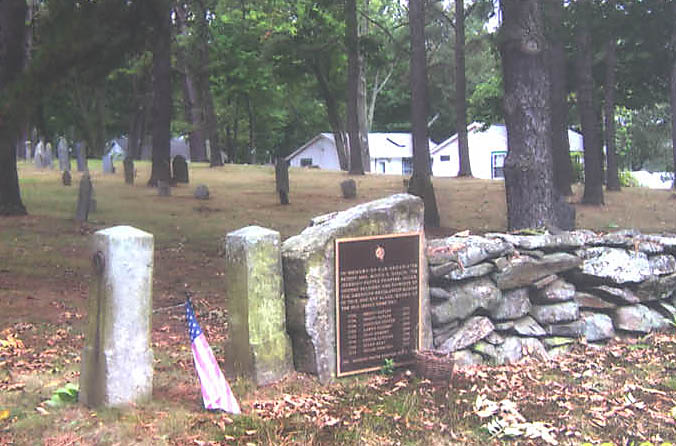
The six haymakers are buried at the Southwest corner of the Old Indian Cemetery, Cottage Street, West Brookfield.
Massacre of the Six Haymakers Reverend Fiske wrote
in his historical sermon in 1775 the following: Biographies: Ebenezer Hayward was born May 22, 1679 at Concord, MA. He was the son of Joseph Hayward, of Concord and Elizabeth Treadway, daughter of Nathaniel Treadway and Sufferance Hayes, who were married on March 23, 1677. This was Joseph's second marriage. The Haywards were one of the old families of Concord, MA. Joseph died at age 71 in October, 1714 at Concord. Ebenezer was 31 years of age when he was killed by Indians in a meadow at Brookfield. John White was a
resident of Concord. He was stationed at the Brookfield Garrison. On July
3, 1707, Sergeant John White was granted 40 acres of upland and 20 acres
of meadow on condition that he live upon and improve the land for four
years, after he is released from public service. The grant was signed
by Thomas Parsons, Constable for Brookfield and approved by the Committee.
Soon after, on November 26, 1707, he was married in Concord to Prudence
Hayward. His grant was confirmed on March 8, 1709/10, while he was still
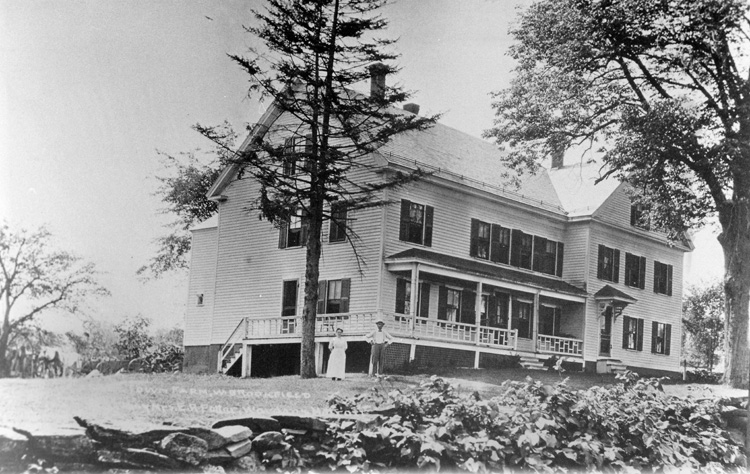
in the service. He probably came to Brookfield soon after and built his
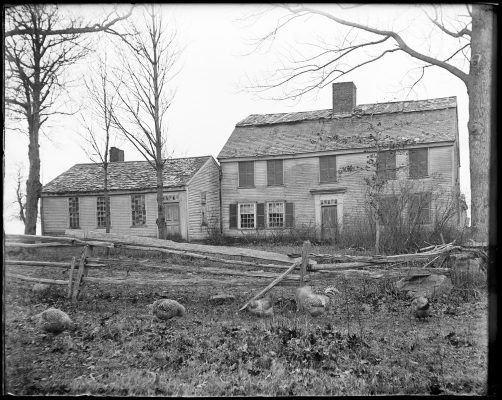
home. The house was built in 1710, about 100 yards west of its present
location. It was moved a few years later and formerly was used as an annex
to the larger White homestead, now the Salem Cross Inn. In 1710, Sergeant
White obtained several other land grants near his home. In addition he
was one of a group allowed by the town: "liberty to build a sawmill
for Brookfield in such a place as they and a good workman shall judge
best, and they have liberty to cut all sots of timber for the use of the
mill in any parts of the precinct, except upon persons property: and had
40 acres of land granted to be divided among them". John Grosvenor, also killed in the above ambush, was the brother-in-law
of Sergeant White, their wives were sisters. John had received a grant
of 50 acres of land on the west shore of South Pond, extending up to the
area between the ponds. The grant was recorded on May 25, 1710. He was
the brother of Reverend William Grosvenor who came to Brookfield in 1706
and may have still been there at the time of his brother's death. Their
father was John Grosvenor, one of the proprietors of Pomfret, Connecticut.
The Grosvenor's came from a prominent English family. Benjamin Jennings, another of the casualties, was the same man who had been wounded at the ambush in 1708, and had been granted an allowance for his injury. On the morning of October 13, 1708, the people at Jennings Garrison heard the firing and set out to assist the people in peril, but were waylaid by the Indians. John Woolcot, a lad of twelve or fourteen, was being pursued by the Indians who finally killed his horse, took him prisoner, and carried him to Canada. Joseph Jennings was wounded in two places and Benjamin was wounded in the leg. The survivors of the ambush were later awarded compensation for their injuries. Benjamin was the son of Stephen and was born about 1690 at Hatfield. Stephen Jennings came to Brookfield from Hatfield and was very influential in the development of the early history of Brookfield. Stephen was well known for his daring and fortitude. In 1677 he accompanied Benjamin Waite to Canada to redeem several captives who had been taken by the Indians. Among the captives, were his recent bride and her two children. Stephen married widow Hannah Gillett on May, 15, 1677, at Hadley. Stephen was also an early and influential settler in the eastern portion of the township (now East Brookfield). His first recorded grant was dated November 15, 1701 and was located in the area now occupied by the southern end of Lake Lashaway. However, prior to this Stephen had purchased the former Prichard estate on present Foster Hill (West Brookfield) on April 14, 1693, from Hezekiah Dickenson and was licensed in September 1695, to maintain a tavern and sell liquor. He continued in the tavern business until 1707, when he sold it to his sons Stephen and Joseph and moved to the Woolcot neighborhood. He had many other grants of land, many of them in the eastern part of the township. On the Biographies link, click Stephen Jennings for an extended biography.
Source: History of
East Brookfield, Massachusetts 1686-1970 by Louis E. Roy, M.D. |
|
Copyright © 2001 West Brookfield
Historical Commission |